Saturday, November 30, 2013

Incandescent Bulb Production to End Forever on Jan 1st

In just 30 days, it will be the end of the light bulb as we know it. With new, stricter efficiency standards almost upon us, it's time to think differently about your lights. In 2007, the US Congress under President George Bush passed the Energy Independence and Security Act. Key among its provisions was a series of regulations mandating the phase-out of the manufacturing, importation, and sale of inefficient lighting. We've already said goodbye to 75- and 100-watt incandescent bulbs, and on January 1, 2014, we'll be bidding adieu to 40- and 60-watt bulbs as well.

Thomas Edison first tested his version of the incandescent bulb in October 1879. Ever since, the screw-in bulb that’s cheap has been the most popular way of lighting homes.

The humble Edison light bulb has enjoyed a long lifespan, seeing only modest changes while technologies like television and radio have been drastically revised over time.

But the familiar bulb's long, uninterrupted reign could finally be under threat as LEDs appear poised to become the new standard.

Thanks, Mr. Edison. Incidentally, you’re fired.

The reason is simple: Traditional incandescent light bulbs lack the efficiency that one would expect of nearly any other piece of modern technology. In fact, about 90% of the energy they use is wasted as heat, with only the remaining 10% actually producing light.

Back in 2007, Congress passed a law setting higher energy efficiency standards. That has led to the phasing out of the production of traditional incandescent bulbs.


Already there are restrictions on the production of 100-watt and 75-watt bulbs. And in 30 days, traditional 60-watt bulbs will be the next to go, followed by 40-watt bulbs on February 28, 2014.

Some have already converted a percentage of the lighting fixtures in their homes to either compact fluorescent or LED lamps. In the long term, the consumer is going to win. But the change could be a tough sell. One retail chain recently cleared out their stock of traditional 60-watt and 40-watt bulbs by selling a four-pack for $0.88, or 22 cents a bulb.

But the problem with a typical incandescent light is that most of the energy needed to light the bulb is lost through heat. Both CFLs and LEDs are much more expensive to buy, with some CFLs selling for about $4 and LEDs anywhere from $10 to $20.

“It’s so easy for a customer to look at just the sticker,” one supplier concedes. "Over the lifetime of the bulbs it’s a different story, financially, because the bulbs are much more energy efficient. The savings to the nation are really substantial,” he said.

LEDs are the energy-saving solution that compact florescent bulbs weren't


 Lighting Science LEDs Save $$$
Click  Lighting Science LED lamps
The most obvious change since 2007 is the wide arrival of high-efficiency LED bulbs that only use a fraction of an incandescent bulb's wattage, and promise to last up to 20 years or more.

Take note, LEDs don't suddenly "burn out" the way that traditional incandescent do. Instead, their brightness fades slowly over a long time period.

Manufacturers can calculate how long it will take the light to fade to 70 percent of its original brightness, and this point, known as L70, is the current definition of an LED that's reached the end of its life.

The LED lamp is not a new invention. But an inexpensive LED is quite new.

Using a seven-watt LED instead of a 60-watt incandescent lamp over the life of the LED can save approximately $130 in energy costs.

[See ElectricWeb | Blogger, Feb 1, 2013]

LED bulbs last even longer than CFLs, and are more than twice as efficient. Plus, LEDs come in shapes like traditional bulbs, unlike the squiggly, spiral look of CFLs.

Those are the good things about compact fluorescent; now for the bad.

Clear the room


Some people don’t care for the light the CFLs produce, finding that the traditional incandescent bulbs are brighter.

Worse, there is a tiny amount of mercury vapor in CFLs. It is the size of the period ending this sentence. But it’s nothing to take lightly: Mercury is a toxic element.

So if you drop a CFL and it shatters, you have a problem.


[See ElectricWeb | Blogger, Aug 8, 2011]

The U.S. Environmental Protection Agency recommends having people leave the room of the shattered bulb, especially pets and children, who are more likely to be injured by mercury vapor than adults.

The EPA said air out the room for 5 to 10 minutes, shut off the central heating or cooling system, and use damp paper towels and stick tape to put the mess into a plastic bag or a glass jar with a metal lid. Do not vacuum the material. It could spread the mercury vapor, and you will have to throw out the vacuum.

Mercury can also be produced by burning coal to produce energy, so the use of more energy efficient bulbs could reduce that. Ironically, the CFL bulb may contain about the same amount of mercury as the coal that was saved by switching light bulbs. If disposed of correctly, then almost none of that mercury will ever escape to the environment.

LEDs don’t have mercury. And, unlike CFLs, they stay cool and can be used outdoors and in cold temperatures.

Indoors, the light from an LED is directional, which is great if you want to light one area of a room. But that means LEDs don’t spread light around a room like an old-fashioned incandescent bulb.

If that’s a problem for you, you may want to consider, believe or not, an incandescent light bulb -- but an energy efficient one.

The law doesn’t ban incandescent bulbs - just energy wasters. It will not be illegal to have the bulbs; however, they no longer will be produced.

There are some incandescents available that are halogen-based. These bulbs cost more than traditional bulbs, but give off the same warm light as the older bulbs.

That’s one choice. But it may not be right for you.

The math is clear


In the long run, consumers are going to save money choosing LEDs.

Tuesday, October 1, 2013

Teen Invents Flashlight Powered by Body Heat

Portable light sources have been one of the most evolving inventions in history -- from the primitive torches and oil lamps of yesteryear, to today's battery-powered flashlights and headlamps. But through it all, most of these illuminating tools have required an outside energy source that would deplete when needed the most. But now, thanks to one particularly enlightened 15-year-old girl from Canada, your next flashlight just might be powered by the heat from your hand. 

At the tender age of 15, Canadian high school student Ann Makosinski has designed and built a flashlight powered by body heat.

Her Hollow Flashlight secured her a finalist slot in the 15-16 age group of the Google Science Fair ahead of thousands of entries from more than 100 countries.

The LED flashlight relies on the thermoelectric effect, with tiles that generate electricity from the differences in temperature to generate electricity.

The tiles are fixed to the outside of a hollow tube so that when held, one side of the tile is heated by the warmth of the hand, while air flowing through the hollow tube helps keep the other side cool. The electricity generated by the temperature differential between either side of the tile powers the LED light.

Makosinski built two different flashlights. The first was made using a tube of aluminum, which is a good heat sink material thanks to its high thermal conductivity, while the second was built using a PVC tube.

Both models work better when the difference between the ambient temperature and body temperature is greater. So while the flashlights worked with an air temperature of 75°F, they emitted more light with the air temperature at 60°F. Both flashlights were able to maintain a steady beam of light for 20 minutes, even in the warmer temperature.


The final cost of each flashlight came to only $25, but if mass-produced, the cost would be substantially lower.

Thursday, September 19, 2013

World’s First Invisible Skyscraper to Be Built in South Korea

Designed by architectural firm GDS Architects, Tower Infinity in South Korea will be the world’s first ‘invisible’ skyscraper. Equipped with an LED facade system with optical cameras, the building will create a reflective skin to display the background behind it on its exterior—allowing it to blend in with the skyline. Developers of Tower Infinity were recently granted construction permits to begin building the skyscraper on the outskirts of Seoul, near the city’s airport.

At a height of 1,467-feet, the building will be used for entertainment and leisure purposes, and will include a 4D Theater, restaurants, a water park, landscaped gardens, and the third-highest observation deck in the world.

“Instead of symbolizing prominence as another of the world’s tallest and best towers, our solution aims to provide the World’s first invisible tower, showcasing innovative Korean technology while encouraging a more Global narrative in the process,” said the company.

Check out the photos for a sneak preview at the world’s first ‘invisible’ skyscraper:


Wednesday, September 18, 2013

What the New York City Skyline Will Look Like In 2020

If current building proposals are any indication, New York's skyline is going to keep getting taller and taller. In the next few years, the skyline will boast 10 new towers. The 1,250-foot Empire State Building, currently the tallest completed skyscraper in the city, will rank third behind 1 World Trade Center and 432 Park Avenue. For an idea of what the city will look like a few years from now, check out renderings of the city that incorporate current construction projects.


Midtown, looking south towards downtown Manhattan:

The Far West Side will look a bit different once Hudson Yards is added:
     

Monday, September 16, 2013

Lighting Science Group Receives $20 Million Investment

Lighting Science Group Corp. recently announced it closed a $20 million preferred stock financing plan led by affiliates of Pegasus Capital Advisors, L.P., with participation from Riverwood Capital Partners, L.P. These companies are LSCG's two largest shareholders. Lighting Science Group received $17.4 million of the funds at the closing of the financing and has received a commitment to fund the balance of $2.6 million. The funding will be used to finance the company's growth, with a strong focus on technology platforms and product innovations.

Click to visit website

Tuesday, September 10, 2013

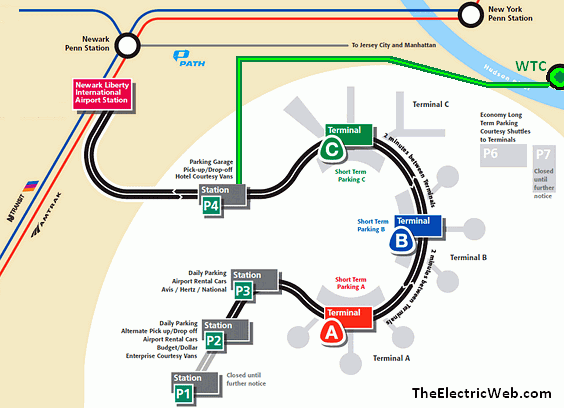
NJ Gov to Back $1B PATH Train Extension to Newark Airport

New Jersey Governor Chris Christie plans to endorse a $1 billion extension of PATH service to Newark Liberty International Airport, according to several sources familiar with the governor's plan. The approval of extending PATH service to Newark Liberty International Airport would mean the money is almost certain to be allocated in the Port Authority's upcoming capital plan. It is not yet clear when Mr. Christie will publicly announce his support for the project.

Governor Christie's backing would almost certainly assure that the extension project, which has been mulled over by transit officials for more than a year, would be included in the Port Authority of New York and New Jersey's roughly $30 billion capital plan, which is expected to be released to the public in the coming months.

The extension would be of special benefit to lower Manhattan PATH riders, who would be able to take direct service from the World Trade Center complex all the way to Newark Airport and transfer to the Air Train to travel to the airport's terminals.

The extension also would offer airport riders a more direct service to Newark-Penn Station on the NEC, a major transfer point to New Jersey Transit rail, light rail, and bus services.

Downtown PATH service currently ends at Newark Penn Station, and the most common approach for riders coming from Manhattan now is to take New Jersey Transit from Penn Station in Manhattan to the Air Train, a route that requires downtown riders to first head to midtown.

Air Train Newark, the three-mile monorail line, opened in 1996 and was extended to the Northeast Corridor in 2000 with the opening of Newark Airport/Rail Station. The station is served by Amtrak and New Jersey Transit.

Airport advocates hailed the decision.

"A one-seat PATH ride from lower Manhattan directly to Newark Airport Air Train is a major step forward," said Joseph Sitt, founder of the Global Gateway Alliance to encourage improvements in the New York City-area airports.

Advocates note those working on airport grounds would also benefit from the improved access to airport terminals.

They also note that PATH's passenger capacity far exceeds that of connecting monorail service, setting up a potential passenger bottleneck for those transferring at Newark Airport/Rail Station.

The project would generate more than $1 billion in design and construction work while adding permanent jobs for the link's operation. The Port Authority has yet to release a start or estimated completion date for the project.

Tuesday, September 3, 2013

Robots on Jobsites? Not So Far Fetched

MIT research scientists insist that the future of home building lies in technology which includes smart machines that can perform construction functions. A professor at USC has invented a fabrication process that operates on the principles of 3D printing. Software able to read blueprints guides a large mechanical arm suspended from a mobile scaffold. The arm extrudes liquefied concrete in patterns that form exterior and interior walls into any shape and height. Electrical, plumbing, flooring, and other finish work can be installed during the process, which operates nonstop until the structure is completed.

In the not so distant future, more and more activities will be operated by software. Instead of Teamsters, there will be robotic trucks. Where there had once been miners, there will be mining robots. Instead of factories, there will be 3D printers in your home.

But, robots on jobsites?

"Yes," says Dr. Khoshnevis, an engineering professor at the University of Southern California, who is betting on home building becoming part of that continuum.

Since 2002, he has been perfecting "Contour Crafting,” a fabrication process that operates on the principles of 3D printing.

Details like cutting window and door openings still are being refined. Khoshnevis has been soliciting investment capital for a startup company to sell the technology. He sees Contour Crafting as being suited for constructing affordable housing in areas where supply is short or where houses have been destroyed by natural disasters. He predicts the technology would reduce jobsite injuries, leave a smaller carbon footprint, and be cost-competitive with stick-built or modular construction after equipment and cycle times are amortized.


His invention might have residual benefits, too. Khoshnevis is working with NASA on a robotic system that could build structures on the moon and Mars using indigenous raw materials such as volcanic sand, which is common on the moon. That’s gotten the state of Hawaii—where volcanic sand abounds—interested in the process for producing cement.

How many years away do you think this technology is to being on jobsites?